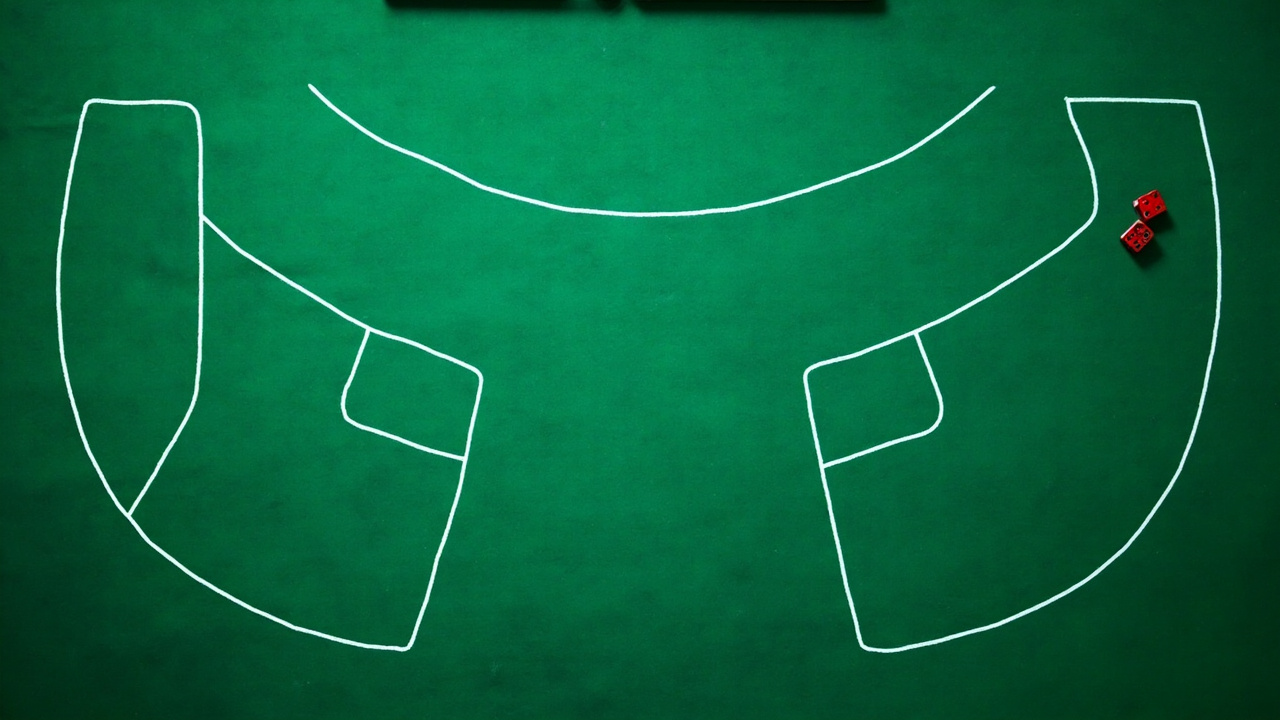
When you approach a craps table, the painted lines and stacked betting squares can feel like a wall of noise. I have spent fifteen years building slot math and simulation specs, so I know exactly how a layout channels player behaviour before a single die is thrown. The same principle applies here: every marker on the felt is a decision point, and understanding that map is the first step to playing with your eyes open rather than guessing at the next roll.
Reading the Felt Before the Dice Hit
The central layout is built around the pass and don’t pass lines, with the come and don’t come boxes sitting just above them, and the proposition bets clustered in the middle. From a design standpoint, that arrangement is intentional: high-frequency line bets keep the action moving, while the centre field offers faster payout maths that the house prices in more aggressively. I have run enough probability models to tell you that a layout is never neutral – it nudges where money sits and how often it turns over. For a Sydney player who has watched a busy Saturday arvo crowd lean over the rail, you will notice most hands gravitate to the pass line first, then drift toward the don’t pass once the rhythm sets in. If you are comparing how venues structure table games across jurisdictions, it is worth noting that the jeetcity7 lobby separates table-style titles from slots in a way that mirrors how a physical layout groups slow and fast bets side by side. The centre proposition squares are the loudest part of the felt, and they are also the most expensive in expected value terms, which is why a player who reads the layout before playing usually starts at the edges and only tests the middle once they understand the odds.
| Detail | What It Means On The Layout |
|---|---|
| Pass line | Primary line bet, paid at even money, anchors the table flow |
| Don’t pass | Opposite line bet, slightly lower house edge on extended play |
| Come / don’t come | Moveable line bets that behave like mini pass bets after a point is set |
| Proposition squares | High-variance centre bets with faster payouts and steeper maths |
| Layout zones | Edges for steady action, centre for faster turnover and higher edge |
Where a Sydney Player Fits On the Table
A practical fit depends on how you want the session to feel, and the layout gives you three clear paths rather than one default. The first is a steady, lower-variance approach where you keep your chips on the pass or don’t pass line and let the come bets extend naturally once a point is established. That style suits a player who wants the table conversation and the rhythm without chasing the centre squares every roll. The second path is more active: you take the line bet as a base, then use the come and don’t come boxes to spread exposure across multiple numbers while the shooter works through a sequence. I have seen simulation outputs that show this middle style can feel busier without necessarily improving the underlying edge, because the layout simply gives you more places to put money rather than better maths. The third option is the proposition-heavy approach, which is exactly what the centre of the felt is built for, but it is also where the house edge bites hardest over time. If you are weighing table pace against your own bankroll tolerance, a short read on wagering at craps can help you separate the excitement of the centre bets from the slower maths at the rails. For a local player, the choice often comes down to whether you want a controlled session around the edges or a faster, more volatile run through the middle.
Comparing the Australian Setup With International Practice
The Australian approach to table games sits in its own lane, and the craps layout is no exception when you stack it against other markets. In the United States, craps tables are common in larger resorts and the layout is often presented with a bigger rail, more signage, and a pace that assumes a crowd watching every roll. In parts of Europe, the same game is sometimes offered in a more compact form, with fewer proposition markers and a slower felt designed for smaller tables and fewer spectators. New Zealand venues tend to run a stripped-back version that keeps the core lines but trims the centre clutter, which changes how new players learn the game because there is less visual noise to sort through. I have worked on game logic across several markets, and the pattern is consistent: the layout is tuned to local table size, crowd density, and how quickly operators want the action to turn. Australia does not have the same density of dedicated craps floors as some US markets, so the tables you do encounter are often set up to be read quickly by a smaller group rather than to carry a packed rail. Belgium and the Netherlands restricted certain loot-box mechanics, and that kind of regulatory attention to how mechanics are packaged is a useful reminder that layout, pacing, and presentation all fall under scrutiny when a market decides how a game should feel to a player. The practical takeaway is that a layout you learn in one market may look slightly different in another, and the core lines remain the same even when the surrounding markings change.
What the Layout Tells You About Pace and Risk
Once you can read the felt, the next question is how the layout translates into session pace and exposure. The edges of the table are where the maths is most forgiving in the short term, because line bets and come bets keep you in the flow without forcing you into the high-variance centre. The middle of the layout is built for speed and spectacle, which is fine if you understand that the faster payout structure is priced accordingly. I have spent enough time on simulations to say plainly that a layout does not lie about its priorities: it tells you where the action is meant to be steady and where it is meant to turn over quickly. That matters for a player deciding how long to sit and how much variance they are comfortable carrying. Matilda Henderson, Sports Betting Analyst, Tasman Gaming Partners, has noted that table layouts influence session length more than most players realise, because the marked zones quietly steer where bets accumulate. Aaron Walsh, Responsible Gambling Adviser, Pacific Wager Analytics, has also warned that players who treat the centre of the felt as the default rather than the option tend to overestimate how long their bankroll will hold up under faster turnover. The layout is not a guarantee of anything, but it is an honest map of where the money moves and how quickly it can move there.
A craps table layout explained well is really a lesson in reading decision points before you commit any chips. The edges give you a steadier path, the centre gives you faster action, and the come boxes sit in between as a way to spread bets without abandoning the line. For an Australian player, the useful move is to learn the felt as a map rather than as decoration, then pick the part of the table that matches the pace you actually want. That way the session starts with intention instead of guesswork, and the layout becomes a tool you can use rather than a wall you have to work around.